Beyond the Fields We Know
‘Whatever I write, I start with the setting . . . ‘
How and why a writer can be inspired by a landscape or location by Marian L Thorpe, author of the Empire’s Legacy Trilogy.

One of my favourite walks is along part of a long-distance path that follows the route of a Roman road that probably follows an even older track. At its North Sea end, wooden henges stood. On either side of the section I walk most frequently, Bronze Age barrows rise from the fields. The ruins of Roman villas lie under the soil not far from it; the moot hill of the Saxon hundred it crosses is believed to be by its side. In The King of Elfland’s Daughter, Lord Dunsany described fairyland as lying ‘beyond the fields we know.’ I don’t write about fairyland, but I do write about a world that lies lightly on a palimpsest of our real, historic world.
Whatever I write, I start with the setting. Stories emerge from landscapes for me, and even when they are complete fiction their settings are strongly based on a real place. Whether it’s verse—the first work I had accepted for publication as an adult—or my short stories, or my novels, they are all rooted in and inseparable from the physical world in which they are set.
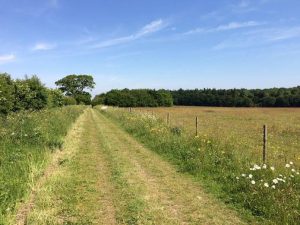 I had a rural childhood of the sort almost unimaginable today. I grew up over 50 years ago, roaming fields and woods and lanes on foot or on my bike, often alone. I watched the progression of wildflowers over the summer; I watched planting and harvest.
I learned to identify trees and birds and wildlife, and understand to some extent the landscape in which I lived and the forces, human and natural, that had shaped it. The theme of the first novel I ever began, at seventeen, is the relationship between a man and the land, the deep, hard-fought and hard-won connection between the two—and that’s still a theme in my Empire’s Legacy series.
The books I loved to read as a child were books that were firmly placed in their landscapes. Ransome’s Swallows and Amazons series; The Wind in the Willows. Puck of Pook’s Hill. Rosemary Sutcliffe, and many, many more. Books where landscape is a character, in a way. I also grew up in a family where history was important. It was discussed, my interest encouraged. My father’s love was Tudor/Plantagenet history; mine evolved into late classical/early medieval.
In my twenties and thirties my husband and I travelled as extensively as we could, not to cities but to the footpaths and trails of almost every country and county of the UK and throughout North America. I soaked up landscape, I soaked up history, and I fell deeply in love with the concept of landscape history. (Thanks, Time Team!) So when I began to write Empire’s Daughter, the first book in the Empire’s Legacy series, I started with a landscape: the coast of Anglesey. I saw it, and then I began to populate it with characters and a society.
 The series isn’t set in the real world, but neither is it truly a fantasy world. There are no variations from the laws of physics or nature, only (barely) a fantasy geography. There are no fae or otherworldly creatures, only the flora and fauna of northern and central Europe.
Every place in the entire series has a real-life inspiration, and I’ve been to most of them. (If I haven’t, I’ve substituted a place I have been, in a similar ecological/geographic niche.)
The reasons for this are many, and varied. As someone who was, for a chunk of her life, a biological scientist, and has been for all her life an amateur field naturalist, I am annoyed beyond words with unreal worlds whose ecologies don’t work. So that’s one reason, but not the major one. The books are set in an analogue world, but it’s one that for many people will be both recognizable and familiar—and that was done on purpose. Because my books explore questions of societal and socio-sexual structures and expectations, because they are more concerned with questions of philosophy and morality and politics than battles, I didn’t want to add another layer of worldbuilding to the mix. It would have been a distraction, another thing for the reader to have to think about and absorb.
In the first two books my main character Lena never leaves the known world, one based entirely on the UK both geographically and historically. There’s a Wall, there’s a country north of the Wall, and these two countries are long-term enemies. The country north of the Wall has a province that sometimes belongs to them, and sometimes to the seafaring people from even further north. Even the battles are based on real ones: Stanford Bridge, the Battle of Maldon. For me, and for anyone who learned British history in any detail, this all should feel familiar – and that’s what I wanted: to place, in a familiar setting, a story that challenges a number of societal structures.
The third reason for the settings of my books is simple: I draw heavily on my own experiences in the descriptions of my characters’ interactions with their environments. I’ve been pelted by hailstones on a mountainside. I’ve slipped on scree; I’ve walked on dusty, arid plains, climbed up waterfalls (not quite as terrifying as the one Lena does), camped in the cold and wet and lived (albeit briefly) in primitive wooden huts. It’s easier to write about real experiences than it is to make them up.
Mix the idea of a world that lies beyond the fields we know, add the discovered and undiscovered history that lies beneath the fields we know, throw in a strong seasoning of love for landscape and nature, a dash of the belief that we are shaped by the places we love, and bake that all in the mind of a writer—and you have the genesis of the world I created in Empire’s Legacy. © Marian L Thorpe 2023
Find out more about Marian L Thorpe’s books on: marianlthorpe.com
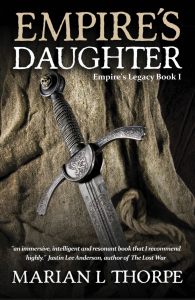 Many generations past, the great empire from the east left Lena’s country to its own defences. Now invasion threatens…and to save their land, women must learn the skills of war.
But in a world reminiscent of Britain after the fall of Rome, only men fight; women farm and fish. Lena’s choice to answer her leader’s call to arms separates her from her lover Maya, beginning her journey of exploration: a journey of body, mind and heart.
Read my review of Empire’s Daughter on Goodreads: https://www.goodreads.com/book/show/54687565-empire-s-daughter
Find Marian’s books on: https://books2read.com/marianlthorpe
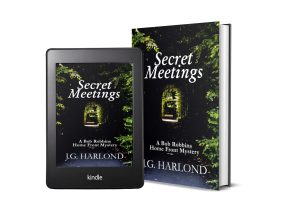
 While researching events in Britain during 1944, I came across a short comment made by someone on a history blog about how Churchill and Eisenhower met for an ultra-secret meeting at a private home on the east coast of Scotland in the month prior to D-Day.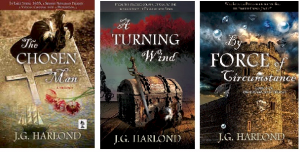
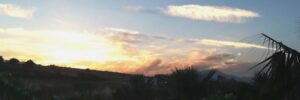
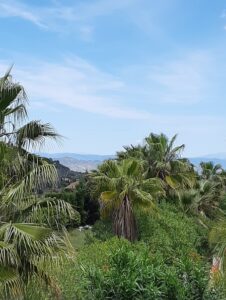 From my desk here in the Province of Málaga I can see the Sierra de Las Nieves. This was where the Moors of Al-Ándalus used to harvest snow to be collected in summer for sherbet and to keep medicines cool. To the right out of a large picture window is the bandalero country of The Empress Emerald; to the left, beyond mauve-shaded mountains, are ancient fishing villages now known as the Costa del Sol, but once prey to the Barbary corsairs featured in The Chosen Man Trilogy.
 Despite my somewhat Latinized outlook, though, what I see through my Spanish picture window when I am at my desk in Málaga is still with a realistic Englishwoman’s eyes.
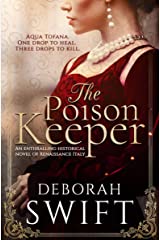 If, like me, you enjoy novels that takes you into the past and/or far away, check out the excellent Bristish historical fiction author, Deborah Swift. She has a new novel set in 17th century Italy out now, too.
 If you enjoy gritty, contemporary British police crime fiction, try B.A. Morton’s frightening, heart-rending ‘Crime on the Tyne’.
 Healthy, well-trained horses entered in modern long-distance races, sometimes called endurance races (for a very good reason) can cover up to 100 miles in a day. The favoured breed is the Arabian, but while the type of breed matters, it’s the training that is important. Each mount has to be prepared for these distances over a long period of time, and this includes getting used to eating hard fodder at different times of the day, which many horses do not or will not do.
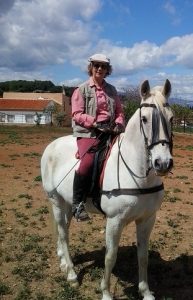 A final word: these blog posts are written from my personal experience of a life-time caring for and training horses. If you go to other on-line sources you may find conflicting or differing information.
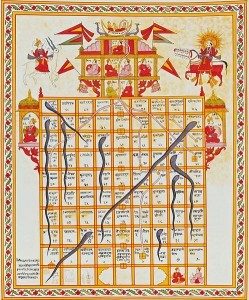 The sheik was seated on cushions in a high-ceilinged room. There were no intricate tiles such as those of the Arab homes Ludo knew in North Africa, only brightly coloured wall-hangings and mats, and on a low oblong table a large patchwork cloth.
 It was the summer of 2001. I picked up a leaflet about an exhibition that was to be held in the museum at Madinat al-Zahra. It was entitled The Splendour of the
 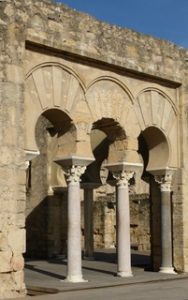 Once the seat of power had been removed from Madinat al-Zahra, the city went into decline. The wealthy citizens left, quickly followed by the artisans, builders, merchants and local businessmen. Its beautiful buildings were looted and stripped of their treasures and the buildings were destroyed to provide materials for other uses. Today you can find artefacts from the city in Málaga, Granada, and elsewhere.
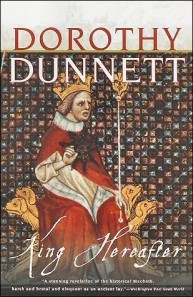 There are two sets of Dorothy Dunnett’s two historical novel series on my bookshelves, plus two copies of King Hereafter: a few are hardbacks the rest are now dry, cracked-spine paperbacks, whose pages are so yellow and print so small that I struggle to read them – but I still do. I’ve bought a few replacements over the past forty years, but somehow can’t bring myself to throw or even give away the originals. The other curious thing about these old books is something very modern. Without strapping any box to my head or standing in any man-made cubicle wearing black goggles they produce a form of virtual reality. Just by looking at a title I can see scenes. Stills and moving images hang in the air: a joyous youth riding an ostrich, the same man now older rides a silken-hide camel; a little boy with sturdy legs runs through apricots drying on a rooftop; a vast eagle swoops across a snowy waste onto an arm; a mad, brave youth runs across moving oars and marries a woman with ‘spawn-like’ eyes . . .
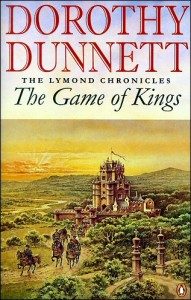 If you recognise any of these scenes you probably qualify as a Dorothy Dunnett fan, and are very likely a ‘historical fiction junkie’. That’s what I was told Dunnett fans were a few years ago. There are currently three Facebook groups for Dunnett fans that I know of. I dip in now and again and am always rewarded by some insight into a bit of history or details on one of the many locations. The news on one today is from a student in Australia who is writing her MA dissertation on Dunnett.