There is a cave in Iceland that I will always remember. It is a place I have never been, but Karen Maitland took me there in Falcons of Fire and Ice and I have never been able to forget it. There is a valley full of butterflies and venomous little snakes on the Isle of Rhodes, and a besieged castle on the Isle of Crete, Dorothy Dunnett took me to both – and Constantinople and medieval Bruges. She took me over rooftops in sixteenth century Blois as well. I can think of many memorable places that I have never visited but somehow cannot forget.
What strange and wonderful power is this that enables an author to create a place so completely in words that a reader will see it in her mind’s eye for years to come? It is an aspect of good story writing often overlooked. Historical fiction reviews, articles and conference panels say much about characters and what they did – the wilder and sadder royals, infamous rogues and feisty heroines – far less is ever said about where their stories unfold. Yet these locations have often inspired the telling in the first place.
This is how Karen Maitland found the cave I remember so clearly and why she had to write about it:
“I was in Iceland. A guide took me to a hillside in the snow and vanished. He had dropped down into narrow slit in the ground, invisible unless you were standing next to it. I followed him down the shaft, scrambling over rocks which formed a natural ladder. At the bottom was a broad stone ledge around a thermal pool. Viking women used come down to give birth in the warm water and the old people were brought into the cave in the bitter winter snows to live on the rock ledges, which were always warm. During the persecutions of the Reformation, local Icelanders hid in the cave and worshipped in the old ways, knowing it would mean a terrible death if they were caught. About twenty years before I went down, the water temperature in the pool suddenly shot up to over 200 degrees centigrade. The water was gradually cooling, though still too hot to touch, and the cave was full of white steam rising from the water. As I stood there, I could almost see and hear the ghosts of all those people who had hidden in the cave over the centuries. It was as if they were circling around me in the silent white mist, whispering their stories.
P.D. James said her crime novels always began with a location. The air, the atmosphere, what she could see and hear and smell not only set the tone for the story, they became the story. Her characters and plots came later. The manner in which historical fiction authors conjure the streets along which their characters walk or ride, the countryside they traverse, the shape and sound of Regency tea rooms, the dampness of dungeons, the musky sweat of unwashed uniforms in wartime dance halls . . . adds significantly to the quality of a book. This description, however, has to be handled carefully, pared down so it does not intrude. A good writer employs the five senses in their descriptions, but with the lightest of touch: a mere whiff of cinnamon in a Goan spice warehouse; the flicker of sunlight on leaves before a forest glade ambush . . . Just enough for the reader to imagine a scene. For this, the author may have done weeks, months of research; travelled hundreds, even thousands of miles. All for a few apt words on a page.
Knowing a place well obviously helps a writer re-create it in words, but in historical fiction this is not enough because the author has to also imagine what that place was like many years ago. Writing about a place in the past – a castle, a workhouse, a landscape – requires significant research because places change; towns grow and absorb villages; villages disappear under volcanoes; forests are felled to provide grazing for sheep; railways are built where canals boats once plied their trade. Entire landscapes change.
Let’s examine these two aspects of setting and location in historical novels a little further. Firstly, when a particular place inspires an author to write about a certain epoch or event, then how and why most authors visit and explore the locations in which their characters lived. To do this I asked authors to comment on their experiences and research, and what or where has moved them to create a novel.
Hilary Green’s Never Say Goodbye grew out of seeing roadside plaques to members of the Resistance in the French Comte region then standing in front of a memorial in the castle of Besançon, where many had been executed.
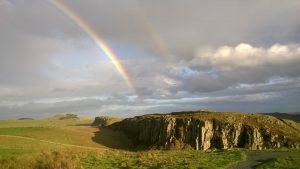 Ruth Downie was impelled to write after a visit to Hadrian’s Wall. What inspired her, though, was what was not there: tombstones for the women who lived with and worked for the occupying Romans.
I was once in the National Trust property Cotehele in Cornwall, preparing to write a sequel to a twentieth century novel when an entirely new story set in the seventeenth century emerged unbidden from the rooms and the portraits on the wall – the view from the roof gave me the absurd fight scene at the end of The Chosen Man before I had even begun.
Monuments and the effect they have on writers can lie dormant for years – until one day that place is just right for a certain story. As a teenager, Joanna Hickson visited Orford Castle, years later that visit became a children’s story, Rebellion at Orford Castle. As an adult, a visit to the Chateau Vincennes outside Paris, where Henry V died, and where ‘the solemn tragedy of (that) event seemed to have seeped into the walls’, reduced her to tears. It was, she says, ‘a story that had to be told’.
This in itself is a little explored aspect of how authors see and present places in their fiction. The story that develops out of a visit somewhere can be heavily influenced by the mood that place generates. And perhaps the mood the author is in at the time.  Elizabeth Freemantle tells of her visit to the Elizabethan house Hardwicke Hall in Derbyshire, which inspired The Girl in the Glass Tower: ‘The place is perched on a hill surveying the surrounding countryside and in my mind it became a glorious prison (for the tragic royal girl, Arbella Stuart)’. Had she visited on another day would the way the daylight lit the walls or her inner feelings have resulted in a quite different novel?
Personal experiences and private histories also influence how writers see places. Living far from home across the world in a remote region of New Zealand, Martine Bailey’s sense of being alien meant she was able to empathise with European women who had been there long ago, some of whom who had been captured by the Maori. The experience led to her writing The Penny Heart. Tom Williams’ first book The White Rajah came out of a visit to Sarawak in Borneo, where he came across the story of James Brooke. To tell the story in greater depth, he travelled up-river to stay with the Dyaks. When it came to writing about the area his own sense of adventure, facing potential dangers and difficulties, can only have informed his writing.
This leads back to how and why authors research locations for their novels. Characters in novels need to act and interact in appropriate and credible settings. Authors also need to check storylines are feasible. This research can lead to surprising and awkward discoveries. While writing Threads of Treason, Mary Bale used ‘a fabulous map of the coastline of Kent as it was during the period of (her) book’ only to find the coastline had changed so much that Lympne, which is now well inland was once by the sea.
Michelle Birkby, writing about The Women of Baker Street, and Sally Zigmond, writing about Harrogate in Hope against Hope, both say that when their characters walk down a street they have to know what they’ll pass on the way, what they’ll smell and hear. As mentioned earlier, in order for a reader to see what is happening in their mind’s eye some writers go to extra-ordinary lengths – and distances – following in their protagonists’ footsteps, even travelling to wild, unpopulated places.
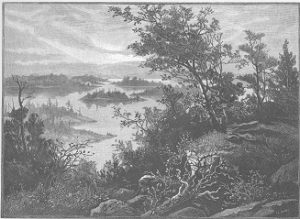 Janet Kellough’s books about the saddlebag preacher Thaddeus Lewis set in nineteenth century Upper Canada (now Ontario) involved exploring the regions he covered, the northern shores of the Great Lakes, even the backcountry.
Closer to a British home, Anna Mazzola has recently travelled up to Skye to find the ‘treeless, bleak, beautiful and sometimes frightening’ spot where her upcoming novel involving dark folkloric beliefs unfolds. Jason Hewitt describes how during his research for Devastation Road he took the same journey as his protagonist, sketching out ideas for scenes as he went ‘a bit like an artist making rough sketches before he returns to his studio to produce the final work’.
Walking where real people of fictitious characters walked to then describe what they might have seen, touched, sensed long, long ago, can be one of the drawbacks to writing historical fiction, though, because it requires time and sometimes considerable expenditure. Is it necessary? Is it worth it? Yes – precisely because the author has to convey what was real then – if not, it’s fantasy?
As someone who is currently writing about Portuguese Goa in the seventeenth century, I agree with Ruth Downie, Google can only take you so far. Re-creating what any place was like in a certain period is, ultimately, an act of imagination, but for it to be effective and affective, it is better if it comes from what the writer has actually experienced.
J.G. Harlond
Photos: Hardwicke Hall – Barry Skeates, Hadrian’s Wall – Ruth Downie, image of Stoney Lake – Janet Kellough.
This article was first published in the Historical Writers’ magazine ‘Historia’: http://www.historiamag.com/a-place-in-history
 Using this information, Price brings to life a long-dead person’s environment and lifestyle. Tombs filled with daily goods such as bowls and combs reveal just as much as those filled with recognisable treasures. Referencing ancient sagas and rune stones, he also shows where the people we call Vikings travelled to, what they sought and sold, and how many, if not most, never went a’viking at all. Some were hunters, many were farmers, others went east and became Rus’ river-traders; some reached Constantinople and joined an elite Varangian unit.
