I recently heard a comment that an author writes what he or she reads. This is possibly true, but herein lies something of a dilemma for modern fiction authors, because these days, to be successful – it is said – one is supposed to choose a genre and stick to it. To become a ‘popular author’ one is advised to write a whole series in a specific genre.
But if we write what we read, how many of us only read one genre? And even if we do, within any category there are all sorts of sub-genres. Up to now my books can all be classified as historical fiction, but they include various types of crime, international espionage, Vatican intrigue and financial skulduggery, swash-buckling pirate scenes and stately royal scandals, and recently, a World War II murder mystery based on the highly secret British Resistance movement set in a Cornish village. And now, to add to this motley list I have to add ‘fantasy’ because it is based on part of the ancient Norse Volsung Saga and includes a shape-shifting, evil-minded dragon. So as you can see, my own reading and research has ranged pretty far and wide. I only wish it had dawned on me to put it all in a series and call it something like a Game of Thrones.
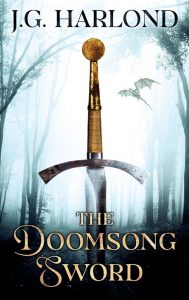
Setting aside the genre dilemma, I will confess to trying to write some of what I have read. This might explain how and why, after ten years as a full-time fiction author, I came to finish (I’d been writing it on and off for years) The Doomsong Sword, which began life as part of a school series on traditional tales – a project that was cancelled during the financial crisis.
I loved, and still enjoy high fantasy with dragons and arch-mages and shape-shifters. As a child, I gobbled up all manner of classic tales and folklore from Narcissus and Theseus to The Little Fool Ivan and the Knights of the Round Table. Later, as a student I dabbled in the academic side of traditional tales and read the Russian folklore analyst, Vladimir Propp. I devoured Ursula Le Guin’s Earthsea trilogy, and then enjoyed it all over again reading it to my own children. Throughout the years of this type of reading, I suppose I have been most influenced by the blurred text where history meets magic: T.E. White’s Once and Future King, Tolkein’s use of Norse tales, and Beowulf, especially Heaney’s translation.
 I can’t say all this consciously inspired me to re-write The Doomsong Sword as a novel, but I was motivated in part by the desire to create a meaningful story out of an old tale for a new generation – my newborn grandson in particular. Davor, the reluctant hero in the story, is an ordinary boy in an extra-ordinary situation: he is lazy and dreams up wild stories to get out of doing his chores. But then he begins to live one, and it is a story more fantastical than he has ever concocted. He not only has to survive alone in the cold Dark Age North with only a wolf-cub for company, but confront all manner of dreadful and frankly outrageous situations, such as finding himself in the home of a three-headed troll and evading the vicious Dwarf, Andvari, under a waterfall. The sword in the title is named ‘Anger, Doomsong and Truth-teller’ in the saga and I had huge fun writing this into my story, although the manuscript went through many, many drafts before it felt right. Weaving bits of Norse mythology into the basic Sigurd, the Dragonslayer legend to create something new – a coming-of-age story that has meaning for a 21st century reader – was not easy. Nevertheless, as soon as I’ve finished the third book in my wily Ludo da Portovenere (17th century) trilogy I’ll be back in the old, cold North to write the ‘Doomsong’ sequel.
This brings me back to being accepted as an author writing in different genres. ‘Genre’ is a convenient concept for online retailers and librarians, but many fiction authors bring elements from a whole range of genres into their new works. The joy of creative writing surely stems from the joy of having been taken into other worlds by other authors; living in past epochs, walking in another person’s shoes in numerous, different types of book. Yes – we probably do write what we read. This is also why children need to read all manner of stories – and daydream. They need to imagine other lives, experience, albeit vicariously, other people’s cultures and world views so that they are better prepared for some of the odd, difficult and perhaps even dangerous things that may befall them in the future. All-powerful dragons and three-headed trolls come in many guises, especially nowadays.
This post first appeared on Tony Riches’ blog on 25th April, 2017, The Writing Desk: http://tonyriches.blogspot.com.es
*Image of Odin and the sword named Gram (Anger), Doomsong and Truth-teller from the Volsung Saga is the woodcut ‘Sigmund’s Swert’ by Johannes Gehrts, 1889.